Monday, August 17, 2009

Cadbury stops using palm oil in chocolate

By MICHAEL FOX - Stuff.co.nz

Cadbury has bowed to consumer pressure and stopped using palm oil in its dairy milk chocolate.

The confectionery giant caused a furore when it was revealed it had substituted cocoa butter with vegetable fat including palm oil.

Palm oil is a contentious ingredient with reports blaming its plantations for huge contributions to global warming and intensive habitat destruction leading to the deaths of orang-utans in Indonesia and Malaysia.

Cadbury New Zealand managing director Matthew Oldham said he was "really sorry" and that the decision was in direct response to consumer feedback, including hundreds of letters and emails.

"At the time, we genuinely believed we were making the right decision, for the right reasons. But we got it wrong,” he said.

"Now we’re putting things right as soon as we possibly can, and hope Kiwis will forgive us.

The change will be made within the next few weeks, he said.

Members of the nearly 3500-strong Facebook group 'Take palm oil out of Cadbury chocolate bars' were jubilant at this morning's news.

"Power to the people", said one member.

"Well done NZ! Excellent... but a shame for Cadbury as I have learnt that other chocolate is good too!” another commented.

Auckland Zoo director Jonathan Wilcken also congratulated Cadbury on their decision.

He said they had met Cadbury and made their position clear. They would now be restocking Cadbury products in the zoo.

Mr Wilcken said it was an issue they had been trying to raise the profile of for some time and they would continue to do so, calling it the “single biggest threat to the survival of orang-utans in the wild”.

Palm oil is derived from the fruit and kernels of the oil palm and is used in cosmetics, cleaning products and many processed foods.

Much of the oil comes from land where existing rainforest has been slashed and burned to make way for Palm oil plantations.

Three quarters of all palm oil comes from Malaysia and Indonesia where rainforests - housing the Bornean and Sumatran orangutans and other flora and fauna - are being destroyed.


Adapted from http://www.stuff.co.nz/

Monday, August 10, 2009

Shopping can save them !

Calling all the human beings out there especially female,do you know that our buying decisions have an impact on the health and survival of the planet?


The following products are produced at great social and environmental cost to Borneo's forests and indigenous communities.


1. TROPICAL PLYWOOD
Lauan, the generic term for tropical plywood, refers to wood from any of hundreds of Dipterocarp tree species. Found in home improvement centers and lumberyards, it is often cheaper and more readily available than domestic hardwood plywood. Lauan is commonly used in: facing for interior hollow-core doors; backing of shelving units, dressers, and drawers; sub-flooring and sub-roofing; and various small plywood needs in general construction. In Home Depot stores, lauan is often falsely labeled as Red Oak. In most other stores, it is labeled 'lauan', 'meranti', or simply as 'Made in Malaysia' or 'Made in Indonesia'.

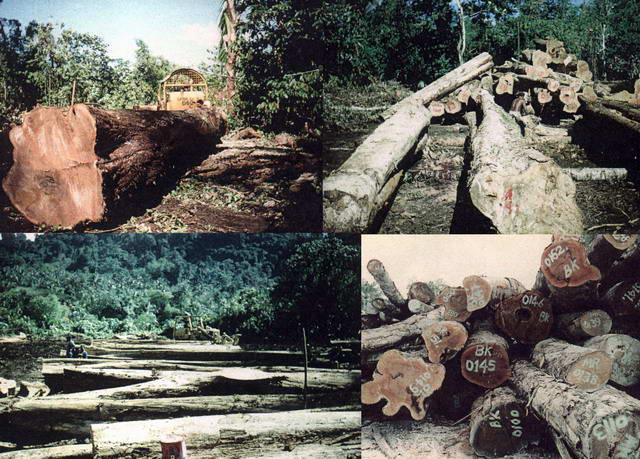
Tropical plywood production has devastated the forests of Southeast Asia, resulting in 80% deforestation in Thailand and 90% in the Philippines. In Malaysian Borneo, over 50% of Sarawak and Sabah has been logged. Indonesia is the world's top producer of tropical plywood, holding approximately 90% of the global trade.

There are a growing amount of non-wood alternatives currently on the market. Visit Rainforestweb for details.

2. DOWELS

Dowels are almost always made of ramin, an endangered tree that grows in Borneo's peat (swamp) rainforests. Most tool handles - from rakes to brooms, mops, plungers and paintbrushes - are made of ramin dowels. A blond wood that at times is stained with a dark finish, ramin is widely used in furniture such as futon frames and garden furniture.

Indonesia is currently the world's largest producer of ramin dowels. Logging is driving this species, as well as the Bornean orangutan, to extinction. (Ramin is an essential part of orangutan habitat). Alternatives to ramin include products made with plastic handles or metal frames. Even if a ramin product has a 'Made in the USA' label, the wood is most likely imported from Borneo and assembled in the U.S.

3. RAYON

Rayon, made from wood pulp, is used to make clothing. Rayon mills are rapidly destroying native rainforests and coastal mangroves, and causing grave water and air pollution problems in many places.

4. PALM OIL

Malaysia and Indonesia are the world's top two producers of palm oil, and most global palm oil production comes from Borneo. Palm oil plantation development involves clear cutting native forests and has contributed to Borneo's frequent and devastating fires. Palm oil is an ingredient in many foods, although it is sometimes listed generically as 'vegetable oil'.

5. TEAK, IRONWOOD, EBONY AND SANDALWOOD

These valuable hardwoods from Borneo are disappearing rapidly. Each is valued for its special properties such as fragrance (sandalwood) or durability (ironwood species ulin or belian). It can take decades for these species to reach maturity. Community reforestation by Borneo Project partners is working to reestablish native trees in areas degraded by logging. Given the species' slow rate of growth, it will be some time before populations of these species recover.

6. PRIMATE PETS


Trade in exotic and endangered species is illegal and a violation of CITES, the Convention on International Trade in Endangered Species of Wild Fauna and Flora. Among common Borneo species traded as pets are the orangutan, the long-tailed macaque, and the pig-tailed macaque. On average, several animals die during capture or transit for each animal sold. Exotic species trade has also been linked to organized crime.


So people, please consider your purchases carefully and opt for alternatives whenever possible =D

Help save the orang utan

2009/06/05

SOME of the people trying to champion environmental issues seem unable to grasp the true meaning of protection, conservation, restoration and rehabilitation, particularly with regard to the orang utan ("Orang utan nursery draws flak" -- NST, June 1).

These ill-informed people should refer to Article 9 of the Convention on Biological Biodiversity (CBD) dealing with the ex-situ conservation that signatory nations, including Malaysia, should as far as possible implement in respect of their endangered species.

The orang utan (Pongo pygmaeus) is our iconic species and could be considered as being at the top of the global list of endangered species. They are facing an uncertain future, and without our help this great ape will soon be extinct.

Unfortunately, of the four great apes, the orang utan is the least studied species (compared with the chimpanzee, the bonobo and the gorilla). By having ex-situ conservation at Tasik Merah, Malaysia is meeting its obligations under the CBD.

Obviously, safeguarding the orang utan in its natural habitat is the best option. However, if their habitats are aggressively intruded, what are their chances of survival? They cannot depend on degraded and fragmented forests, not to mention logged forests.


As frugivores, they forage mainly on wild fruits. Their habitats need to include various species of fruit trees, including fig trees. Due to habitat destruction, their populations are dwindling at an alarming rate.

Education and research are the main issues that can guarantee the future of our orang utans. Schoolchildren and university students who have visited the orang utan island near Bukit Merah have become more knowledgeable about this endangered species. It has also enlightened other visitors, including foreign tourists.

Therefore, I urge those people who have a negative perception of the orang utan island and what is being done there to pay a visit to this sanctuary to learn about the true nature of the conservation effort.

I sympathise with the orang utan centre's chief veterinarian, Dr D. Sabapathy when he asks, "People say the species is close to extinction but what are they doing about it?". I have heard enough from some quarters who are unnecessarily trying to politicise this environmental issue.

MASHHOR MANSOR,Professor School of Biological Sciences Universiti Sains Malaysia

Adapted from NST Online

Love it?

Are you obsessed over


this?

Do you know every time you pay for this chocolate and melt it in your mouth, you have already contributed in destroying orangutan's home? Don't believe? Read the article.


Target:
Cadbury
Sponsored by:
Carly Day

Cadbury have long been a household favourite throughout New Zealand, even recently being voted NZ's most trusted brand last. Unfortunately they rapidly dishonoured this title with the introduction of Palm Oil into their chocolate.(Check out here)

Palm Oil is labelled as Vegetable Fat on their chocolate labels. It decreases the quality and pleasant taste of the chocolate, it is higher in saturated fat, and the Palm Oil industry is one of the leading causes of deforestation in Indonesia.

Orangutans are on the brink of extinction due to this industry. Both the Bornean and Sumatran subspecies will be extinct in 12 years unless the slash and burn of rainforests to create Palm Oil plantations is slowed. Countless other endangered plants, animals and local people are also suffering.

Many responsible companies are looking for ways to decrease their use of Palm Oil due to the difficulty in finding a truly sustainable source.It has been shocking to countless numbers of Cadbury fans to find that Cadbury have gone the opposite direction and increased their usage!

Although Cadbury claim to be using Sustainable Palm Oil we question this claim as they have yet to back it up with details and proof.

They justify their use of this product by touting their membership of the Roundtable for Sustainable Palm Oil (RSPO) but as yet being on the RSPO does not require any commitment other than paying a fee.

There are a number of companies that belong to the RSPO who continue to destroy rainforest while using their membership as a cover.

Cadbury has the ability to become pioneers and lead the way for other global corporations by expending the extra effort and money required to make positive changes.

Cadbury - we implore you to remove Palm Oil from your NZ chocolate products. We will boycott your products as long as they contain Palm Oil that is not 100% CSPO.

Adapted from Care2petitionsite

Meet Elmo =D


He's gonna be good friend of Koko I guess=D

Malaysia opens orangutan safe heaven

A new heaven has been built in Malaysia for North Borneo Orangutans in an attempt to save them from extinction. Reuters Sonia Legg reports.

Can Koko and family swim?

Posted on 17 March 2009

Kota Kinabalu – Desperate times calls for desperate measures. Wild orang-utans spend 90% of their time on treetops, and very rarely descend to the ground, unless disaster strikes.

A WWF-Malaysia field staff in Lower Segama recorded this series of photographs illustrating the rescue of a wild orang-utan mother and her baby who had been hanging on to a laran tree for a week due to flood in the area. A unit from the Sabah Wildlife Department was rushed to the site and a rope bridge was immediately set up about four metres from the shore.

The orang-utan mother grabbed the rope bridge as soon as the rope bridge was thrown across to her direction.

She began her descent from the tree while still holding onto the rope. Her baby was seen to be tightly clinging onto her.

The mother made sure heads were above water while she swam across. At the shore, the orang-utans fed for about 30 minutes before heading back into the forests.


Previous documentation had stated orang-utans to be non-swimmers, supposedly due to their fear of water. However, this new discovery shows that orang-utans are actually able to swim in desperate situations, with the help of a tool.

Last month, Sabah received a high record of rainfall which undoubtedly affected the wildlife in some lowland areas. Like this orang-utan, some were able to save themselves to higher ground. Floods caused by excessive rainfall are likely to intensify under future climate change scenarios. But how many can escape in the future?

Adapted from WWF Malaysia